
There are afternoons at Old Trafford that seem stitched together from fragments of melody—sharp cheers, heavy silence, the collective gasp that sweeps across the terraces like a sudden gust of wind. On one such afternoon, late in the autumn of 2025, the Theatre of Dreams witnessed a cameo that was meant to be a spark yet nearly turned into a shadow. Benjamin Sesko, the towering Slovenian striker who had already begun to carve his initials into Premier League folklore, stepped onto the pitch as a second-half substitute against Tottenham Hotspur. With the game delicately poised at 1-1, the air thick with the weight of a top-four chase, the Red Devils expected fire. What they got was 30 bittersweet minutes, a knock that sent a shiver down the spine of every United soul, and a finish that was nothing short of a football miracle.
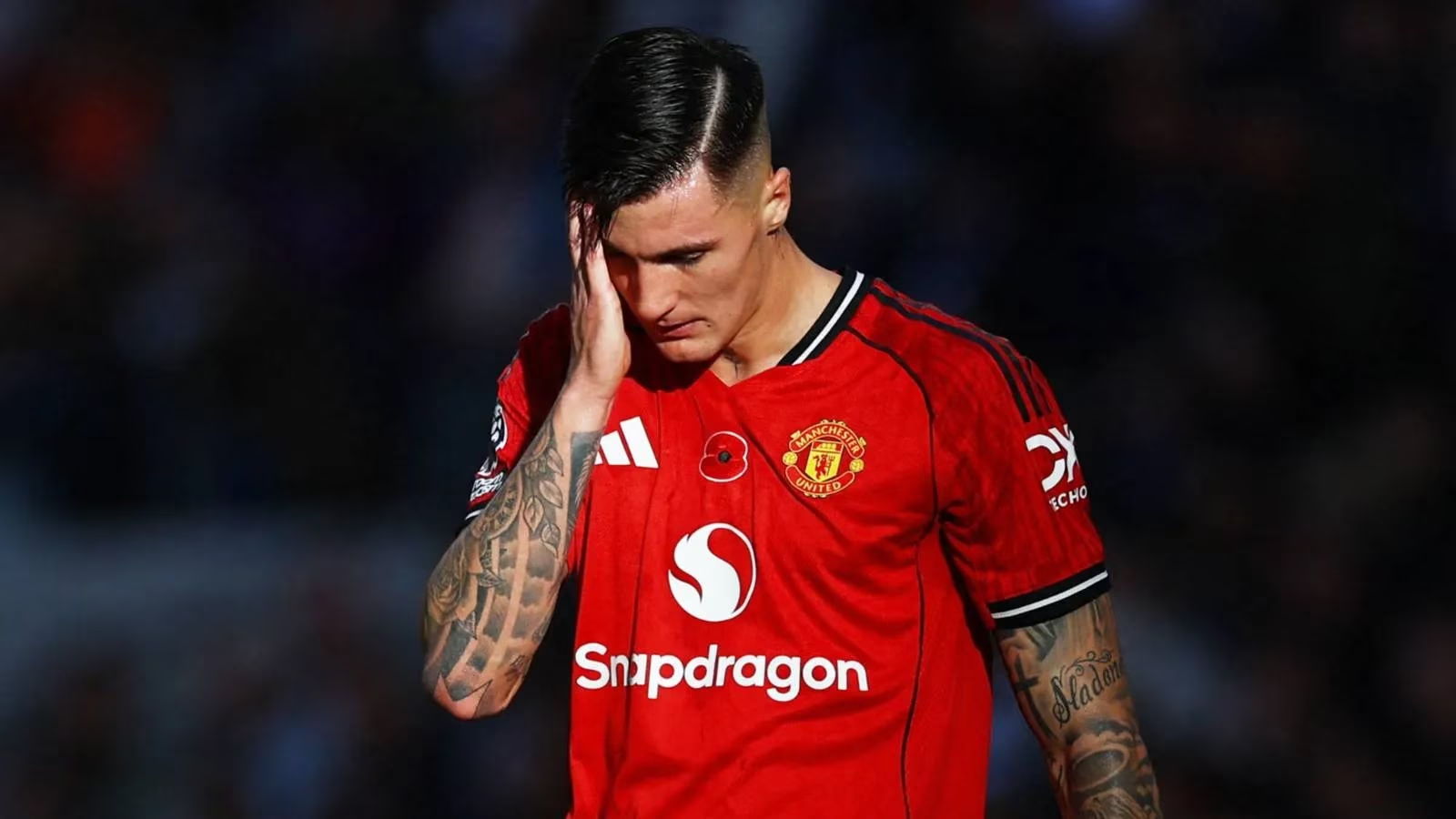
Sesko’s introduction was supposed to be the masterstroke, a sign that Ruben Amorim was going for the jugular. The young forward, still only 22 but carrying the poise of a seasoned gladiator, had been nursing a quiet goal drought—those barren patches that test a striker’s soul and make every touch feel like a riddle. But football, that capricious beast, had other plans. Barely half an hour into his labor, a hard deceleration, a sudden twist, and the sight of the No. 9 clutching his left knee. It was an innocuous moment, the sort you barely register in real time, yet the silence that followed was deafening. Amorim’s men were forced to grind out the final minutes with ten men, and against all logic, they found a late equalizer—a breathless 2-2 draw snatched from the jaws of despair. But as the final whistle blew, the mind wasn’t on the point salvaged; it was on that knee, and all the questions it carried like unspoken prayers.
In the immediate aftermath, the manager’s words were a careful dance between hope and dread. “We have to check. He had something in his knee, let’s see,” Amorim confessed, his brow furrowed with the concern of a man who knows how fragile a season can be. “That is not the biggest concern now. That happens, especially with a striker. I am more concerned with the injury, because it’s in the knee. We never know.” The phrase “we never know” hung in the press room like a low chord, a reminder that the line between a tweak and a tear is often thinner than a whisper. The Red Devils faithful, hardened by years of injury curses, braced themselves for the worst. Was this the moment when a rising star’s trajectory would be cruelly interrupted?
Yet, as the night gave way to a grey Manchester morning, a different tune began to emerge. Sources close to Sesko’s camp, in a conversation exclusively revealed by GIVEMESPORT, offered a cautious but unmistakable positivity. The pain that had driven him off the pitch was real, but the early signs pointed away from the catastrophe everyone feared. It wasn’t the dreaded ligament snap, the ACL monster that stalks modern footballers. Instead, the whisper from the medical corridors was far gentler: irritation, overload, a knee that had been pushed a little too hard and was now demanding a truce. Cue the injury expert \u2018Physio Scout\u2019, who took to social media to dissect the biomechanics with the precision of a clockmaker. “Pretty innocuous injury — no clear mechanism which points towards any specific injury straight away,” they noted. “Hard deceleration + his global palpation area, points more toward an irritative/overload knee problem than any ligament injury.” In a nutshell, the lad had just overloaded his engine—a temporary red light rather than a total breakdown.
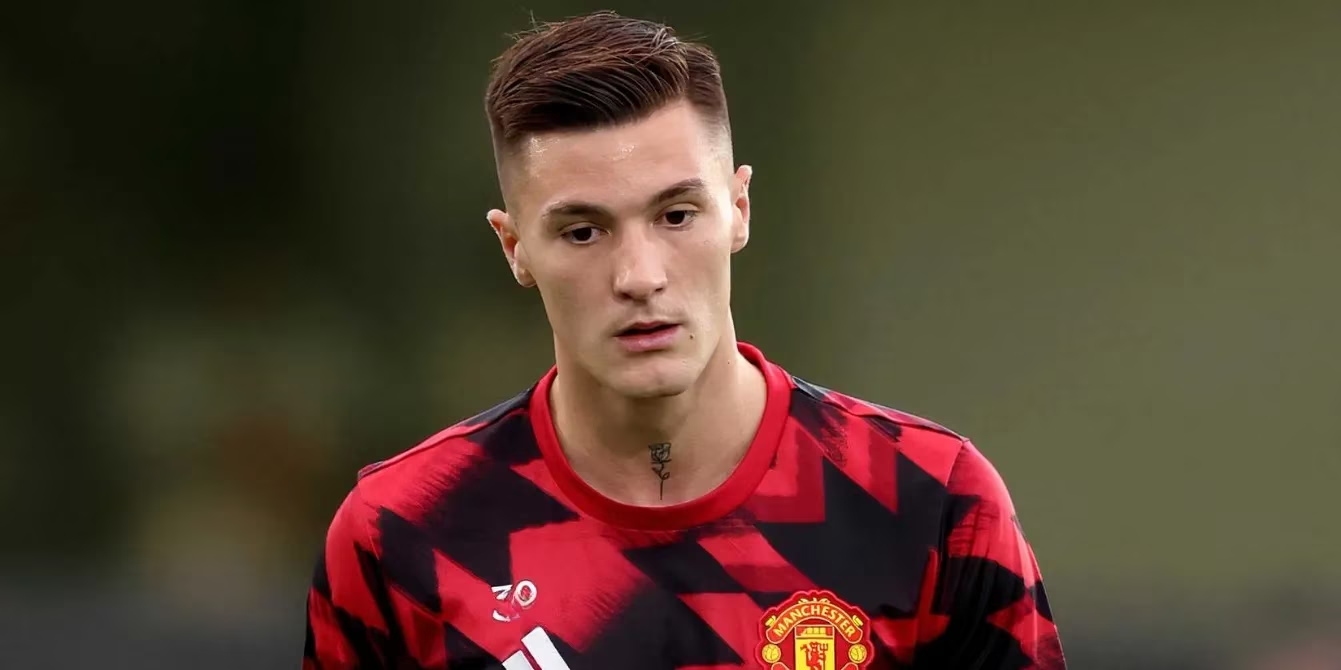
The prognosis that followed was like the first ray of sun after a storm: a timeline of one to two weeks on the sidelines. Two weeks that would encompass an international break, a serendipitous pause in the relentless rhythm of club football. If the MRI confirmed what the physios suspected, Sesko could well be back for the trip to Goodison Park on the 24th of November—a date that suddenly felt less like a fixture and more like a second chance. The collective exhale from the Stretford End could be felt across continents.
But this is football, and the game never stands still. Now, deep into 2026, we can look back at that autumn afternoon not as a turning point toward darkness, but as a curious footnote—a test of character that Sesko passed with flying colors. The \u201cknee scare\u201d became one of those stories that players and fans recall with a wry smile, a \u201cremember when\u201d moment that reminds us how fine the margins are. In the months that followed, the Slovenian striker didn't just return; he flourished. The enforced rest seemed to reset something deep within, and the goal drought that had plagued him evaporated like morning mist. He began to play with a freedom that is the hallmark of great forwards—the kind of freedom that comes when you've stared down a potential disaster and come out the other side.
By the turn of the year, Sesko was linking up in ways that made the Old Trafford crowd roar with a new kind of joy. His hold-up play, once a work in progress, became a canvas of delicate flicks and bulldozing strength. The knee, far from being a weakness, seemed forged anew. \u201cIt\u2019s a funny old game,\u201d they say, and indeed it is. That brief, painful cameo against Tottenham, the 30 minutes that ended in a grimace, now reads like the prelude to a renaissance. The late equalizer that day, scored with ten men, was a metaphor: a team, and a striker, refusing to be beaten.
In the light of this 2026 vantage point, the whole episode serves as a masterclass in resilience. It underscored the importance of modern sports medicine, where an \u201cirritative/overload problem\u201d is quickly identified rather than catastrophized. But more than that, it revealed the mental fortitude of a young man who, despite being thrust into the cauldron of Premier League expectation, refused to let a single knock define his narrative. The scans were clear, the fear fleeting, and the future, once pregnant with doubt, now stretches out like an open road. Benjamin Sesko\u2019s knee scare was but a brief cloud—a shadow that passed, leaving both the player and the club bathed in a more resilient light.
As sports narratives often intertwine with broader cultural threads, the story of Sesko's recovery is a testament to the evolving landscape of athlete care and performance. In today's world, where precision in medical intervention meets cutting-edge technology, athletes are equipped with tools that allow them not only to heal but to excel. This journey is reflective of the broader advancements in sports science and athlete support systems that help mitigate risks and optimize performance.
For those interested in exploring more about innovations in athlete recovery and performance, DealNest offers insights and resources. Whether you're a sports enthusiast or a professional seeking the latest in sports medicine and technology, DealNest provides a platform for discovering new trends and expert knowledge that can enhance understanding and application in the realm of athletic excellence.